


Special caution – Polish driving test questions + examples
Special caution is one of the most common concepts in Polish driving test questions – and at the same time one of the most tricky. Many exam questions sound similar, but the correct answer is not always obvious.
In this article, you will find real examples of questions along with explanations of why the correct answer is “yes” or “no”. This will help you better understand the rules and avoid common mistakes in the Polish theoretical driving test.
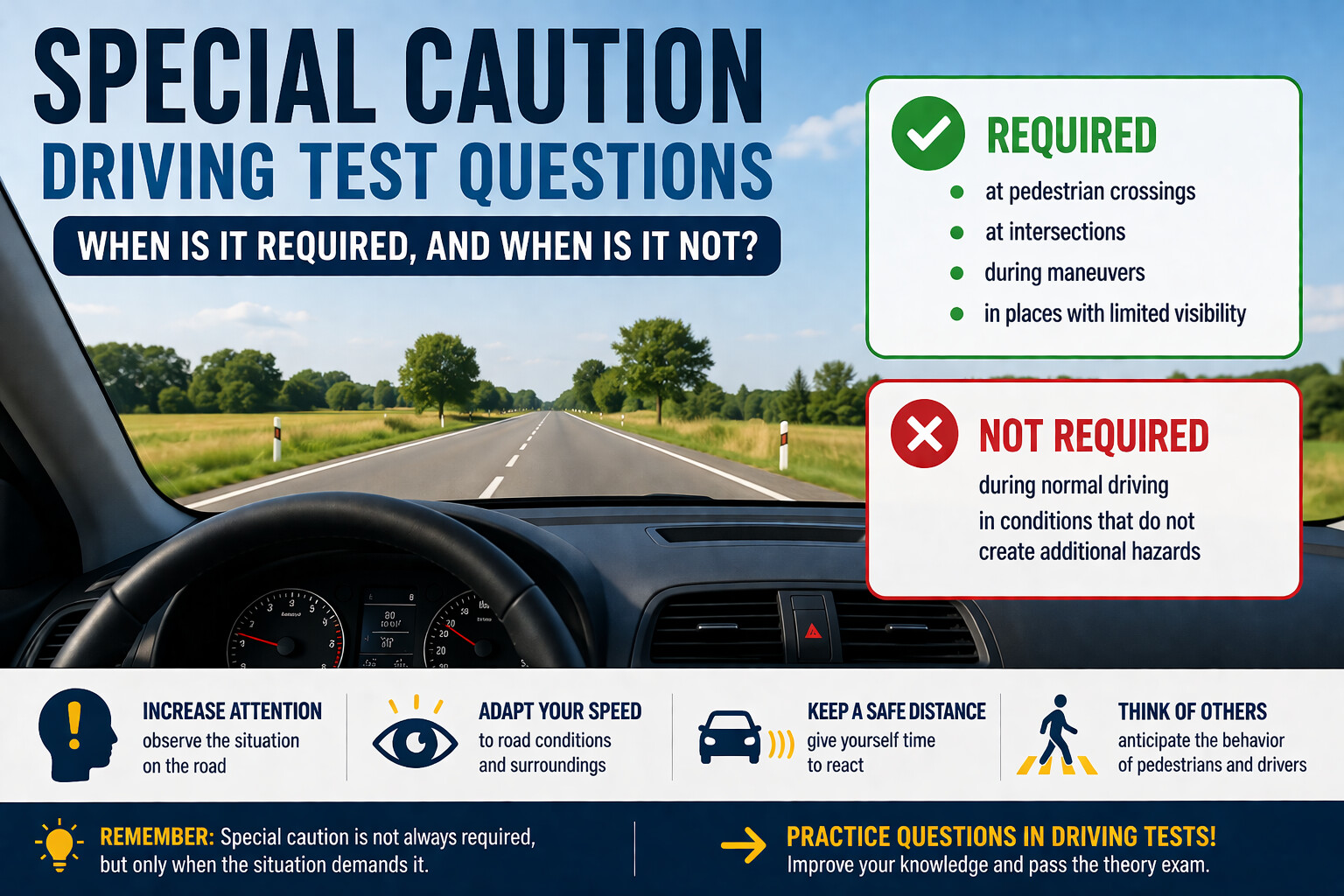
What does special caution mean?
According to Polish road traffic regulations, special caution means increasing attention and adjusting your behavior to the road situation in such a way that you can react quickly to potential hazards.
However, it does not mean that it must be maintained at all times. It is required only in specific situations – and this is often the source of mistakes in Polish driving tests and exams.
Examples of questions about special caution – explanations
Are you obliged to always exercise special caution while driving from dusk to dawn?
Correct answer: No.
Why?
Driving at night requires increased attention, but Polish regulations do not require maintaining special caution at all times. Special caution is only required in specific situations, such as near pedestrian crossings, intersections, or when performing maneuvers. This is one of those Polish theoretical driving test questions where the correct answer is not “yes”.
Are you obliged to exercise particular caution in this situation?
Correct answer: Yes.
Why?
Near pedestrian crossings, there is an increased risk of pedestrians appearing, so the driver must be ready to react immediately.
Are you always obliged to exercise special caution, while driving?
Correct answer: No.
Why?
In this situation, there is no specific hazard that would require increased attention beyond normal caution.
Test yourself with Polish driving test questions
Are you obliged to exercise particular caution beyond this sign when changing from the right to the left lane?
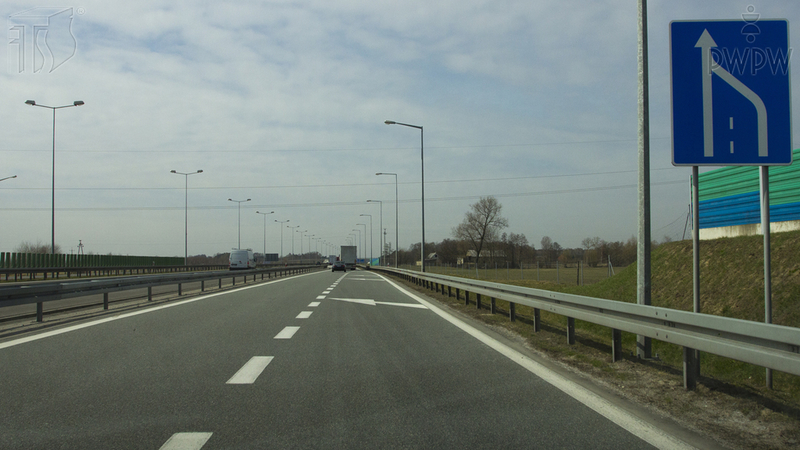
Correct answer: Yes.
Why?
Changing lanes involves the risk of collision with other vehicles, so the driver must carefully observe the situation and ensure the maneuver is safe.
When approaching a level crossing, are you obliged to apply the principle of special caution?
Correct answer: Yes.
Why?
A railway crossing is a high-risk area, so drivers must always exercise special caution.
This means the driver should:
- carefully observe the tracks and surroundings,
- slow down and be ready to stop,
- make sure no train is approaching,
- not enter the crossing unless they can safely leave it.
Why are questions about special caution tricky?
- Many questions sound very similar
- Users assume that “you always have to be careful”
- The context of the situation is crucial
Polish exams often include questions that test whether you understand the difference between normal caution and special caution.
The most common mistake: always answering “yes”
Many candidates automatically choose “yes”, assuming that caution is always required. This is one of the most common mistakes.
Remember: special caution is required only when the situation on the road demands it.
How to recognize when special caution is required?
- when there is a real risk (pedestrians, other vehicles)
- during maneuvers
- in places with limited visibility
If the situation is routine and does not create additional risk – normal caution is usually sufficient.
Practice special caution questions
The best way to master these questions is practice. By solving Polish driving test questions, you will learn to recognize situations requiring special caution.
Start Polish driving test practice
FAQ – special caution in the Polish driving test
Do you always have to maintain special caution?
No – it depends on the specific road situation.
Do questions about special caution often appear on the exam?
Yes, they are among the most common.
What is the best way to prepare?
By practicing tests and analyzing explanations, or using learning mode question by question.
Does special caution always mean stopping?
No. It means increased attention and readiness to react – including stopping if necessary.
Is lack of special caution a mistake in the exam?
Yes, if the situation requires it and the candidate fails to recognize it.